Blog
GitHub Copilot Fusion: It Picks the AI Model So You Don't Have To
GitHub made Copilot Fusion generally available on October 28. It routes every coding task to the models it chooses. What that changes for cost, control, and how you review AI work.
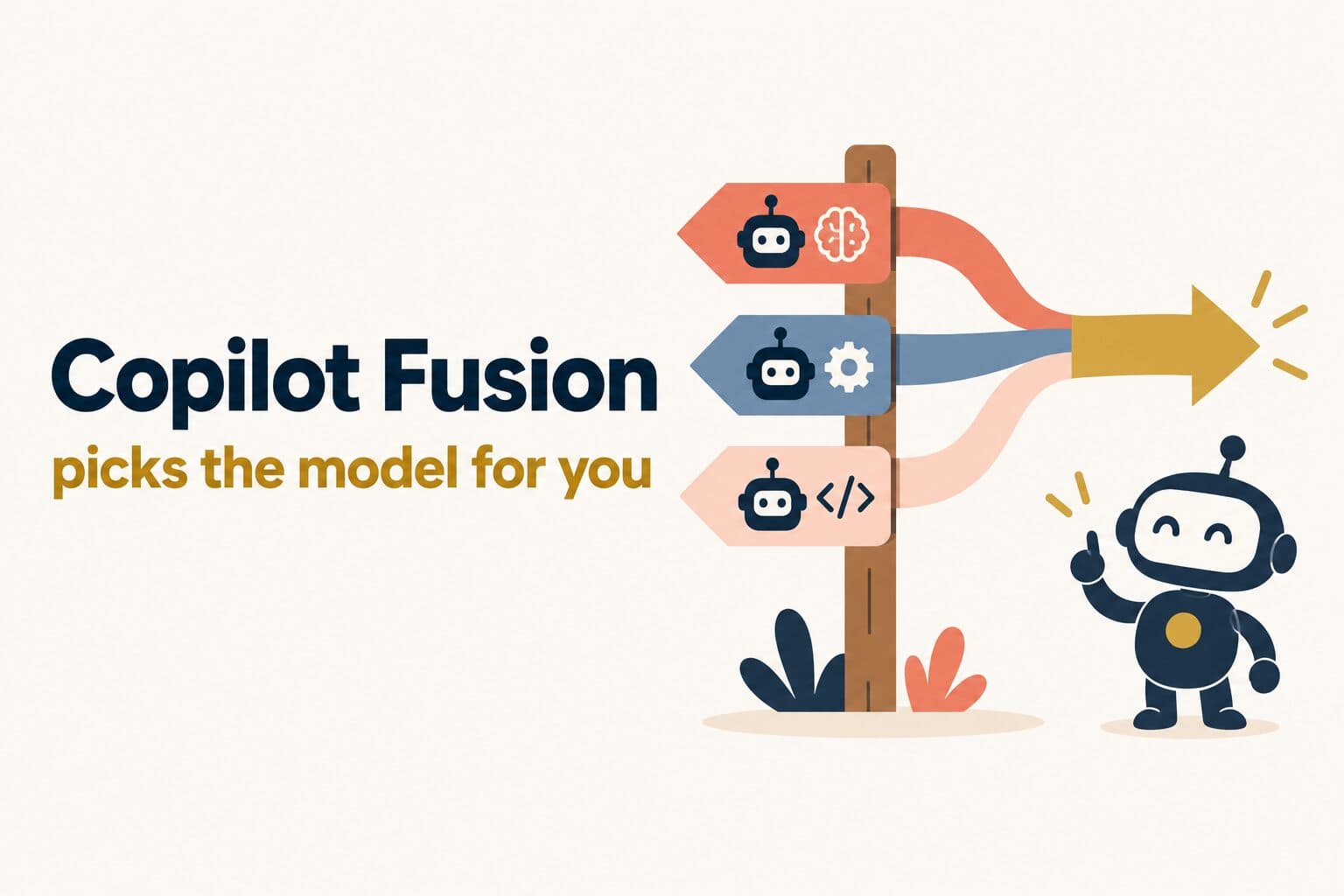
GitHub Copilot Fusion: It Picks the AI Model So You Don't Have To
On October 28, GitHub made Copilot Fusion generally available, announced on stage at GitHub Universe in San Francisco. The idea is simple to say and big to think about: you stop choosing which AI model writes your code. Copilot chooses, task by task.
Until now, using an AI coding tool well meant knowing the model menu. Fast model for small edits. Expensive model for the hard refactor. Remember to switch back. Most people did not switch back, and the invoice showed it.
What Fusion actually does
When you pick Copilot Fusion in the model picker, you are not picking a model. You are picking a system that routes each task to the models it decides to use, and decides how they work together. GitHub merged two earlier experiments into it: Project HydraFusion, which orchestrates several models on one job, and Copilot's automatic model selection.
You keep exactly one decision: effort level. Fusion Standard for everyday coding, Fusion High for harder tasks and deeper reasoning, Fusion Max for the most demanding work.
Behind that one switch, Fusion runs one of three workflows per task. Single: one model does the job. Cascade: a cheaper model drafts, a quality check decides whether to accept or escalate to a stronger model. Critique: one model drafts, a second reviews it, the first revises.
The numbers, with a label on them
These are GitHub's own reported figures, so treat them as vendor numbers, not independent tests. On the Artificial Analysis Coding Agent Index, GitHub says Fusion Max scored 60, within two points of Claude Code with Opus 5.5 Max, at about half the average API cost per task, using about half as many tokens and about 40% less time per task. The New Stack's write-up repeats the same figures from GitHub's announcement.
AT&T principal software engineer Hari Pokhrel, quoted in GitHub's release, says Fusion Standard improved token efficiency across AT&T because developers no longer pick a powerful model for one hard task and then forget to switch back. That matches what I see in small teams: the waste is not the big jobs, it is the hundred small ones run on the expensive model out of habit.
What it costs
Fusion is available on all Copilot plans, in VS Code, the GitHub Copilot app, the Copilot CLI, and JetBrains IDEs, with more clients promised.
Billing works like this: you pay for each model Fusion actually uses, at that model's standard rate. For a limited time, paid Copilot plans get a 30% discount on those model costs. Two things to note. The discount is temporary. And your bill now depends on choices the system makes, not choices you make.
If you run a team, there is one more layer. Administrators can control which models Fusion is allowed to pick from, disable specific models for Fusion only, and set Fusion as the default for everyone.
The bigger pattern
GitHub is not alone here. The New Stack notes that Ramp moved model selection into its open-source coding agent this month, and Replit made intelligent model routing the default on every account over the summer. Model picking is quietly becoming the tool's job, not yours.
What it means for operators (Jaden's take)
My read: this is the same trade as every always-on agent this fall, one level down. You are not delegating the work this time. You are delegating the decision about who does the work.
That is mostly good. Picking models is exactly the kind of expert chore that eats attention and rewards nobody. If Fusion's routing is even close to GitHub's numbers, the average small team saves money by handing it over.
But notice what changed in the billing section: you now pay for decisions you did not make. So do this. Turn Fusion on for a week on Standard, run your normal work, and compare the bill and the output quality against your previous week. Check the per-model usage in your Copilot settings before the 30% discount makes everything look cheaper than it is. And keep your existing rule for anything the agent sends, commits, or merges: it waits for your approval, same as before.
The skill that matters in 2027 is not knowing which model to pick. It is knowing how to check the work of a system that picks for you.
Scenario, not fact: if routing becomes the default everywhere, "which model do you use?" stops being a question operators ask, the way "which server does your website run on?" already has.