Blog
Is the 'Perfect Daily Routine' Real? What the Evidence Says
A Korean infographic promises the best daily routine based on neuroscience. Here it is in English, and what public health guidance and research do and do not support.
Is the "Perfect Daily Routine" Real? What the Evidence Says
A Korean wellness infographic has been going around: "The Best Daily Routine, Based on Neuroscience." It lays out a full 24 hours, from sleep to a wind-down, and attaches a "brain science point" to every block.
It is tidy and easy to like. I translated it below, then checked the claims against public health guidance and published research, because a good-looking schedule is not the same as good evidence.
General information, not medical advice. If you have a sleep disorder or a health condition, or take medication, talk to a clinician before changing your routine.
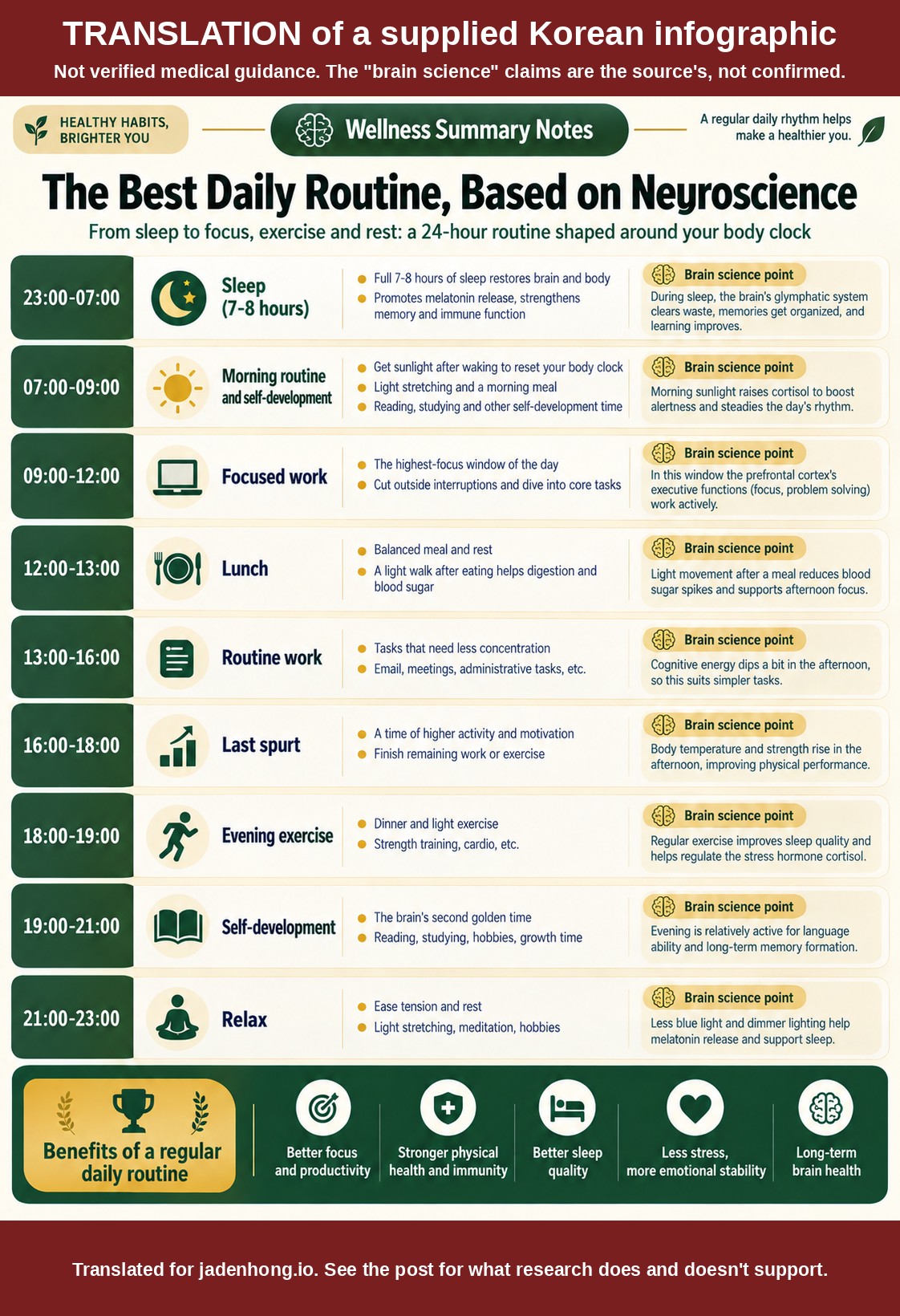
This is a translation of the original graphic. The "brain science points" are its claims, not mine, and not all of them hold up as stated.
What holds up
Sleep: at least seven hours. The CDC lists 7 or more hours a night for adults 18 to 60, and 7 to 9 for ages 61 to 64. The graphic's "7 to 8 hours" sits inside that.
Movement: the weekly amount matters. CDC guidance for adults is at least 150 minutes a week of moderate activity such as brisk walking, plus muscle-strengthening on 2 days. It can be split up across the week. Neither CDC nor WHO names an hour of the day. The WHO lists sleep among outcomes that improve with regular activity.
Light sets your body clock. Light is the main cue for the sleep-wake cycle. A systematic review links the amount and timing of light to sleep outcomes, and bright morning light is used to shift sleep timing in people who fall asleep too late. "Get daylight after you wake up" is a reasonable habit. It is not a guarantee of better sleep.
A walk after eating. A meta-analysis of eight crossover trials (116 people, 47 with type 2 diabetes, rated high risk of bias) found that exercise after a meal lowered the post-meal blood sugar rise compared with sitting, and worked better than exercise before the meal. Walking soon after eating (within about 30 minutes) looked best. It measured blood sugar, not afternoon focus.
Dim lights and screens before bed. A review of digital device research concluded that evening screen light can interfere with sleep, with delayed sleep onset seen at fairly low screen brightness. Blue-light blocking glasses are less certain: a meta-analysis of 12 studies found inconsistent results.
What is overstated
"Morning sunlight raises cortisol." Cortisol does rise sharply in the first 30 to 45 minutes after waking. That is well documented. Whether bright light changes cortisol is less clear: a review of human studies called the findings inconsistent, depending on light intensity, duration and timing.
"Regular exercise in the evening improves sleep." A systematic review of 23 studies found the evidence does not support the idea that evening exercise harms sleep in healthy adults, and even slightly increased deep sleep. It also noted that sleep onset, total sleep time and sleep efficiency might be worse after vigorous exercise ending within an hour of bedtime. A later network meta-analysis of 28 small studies found moderate evening exercise ranked best, and that high-intensity evening exercise reduced REM sleep by about 2 percentage points compared with none. These were short studies of healthy adults who slept well.
"Sleep clears brain waste (the glymphatic system)." The glymphatic idea is real and widely discussed, and much of the evidence comes from animals. A 2024 Nature Neuroscience study in mice reported that brain clearance was reduced, not increased, during sleep and anesthesia. Other researchers published a critique of its methods in 2025, and a 2026 review concluded the conflicting results cannot be settled yet because there is no agreed way to measure clearance. Sleep matters for memory and health. "Sleep flushes out toxins" is a hypothesis, not a settled fact.
What I could not back up
A fixed focus window of 09:00 to 12:00. A 2025 systematic review of 65 studies found that more than 80% showed no overall effect of chronotype (being a morning or evening person) on cognitive performance. In adults 18 to 45, 29 of 64 studies (45%) found people did better at their own best time of day, mostly in attention, inhibition and memory. In older adults it was 10 of 12 studies. So timing can matter, but it differs between people. The review also notes that more research is needed.
Afternoon temperature and strength, and a "second golden time" for evening learning. I did not find solid support for the afternoon body-temperature and strength claim, or for evening being a special window for language and long-term memory. Some of it may be true for some people. I am not calling it false, only unproven as a rule for everyone.
The benefits bar. Better focus, sleep, immunity, mood and brain health are all plausibly linked to regular sleep, activity and rest. But the infographic implies this exact schedule delivers them. Nothing I found shows that.
So how does wellness work?
- Regularity beats a perfect timetable. Similar sleep and wake times, daylight, regular meals and movement on most days are the common thread in the guidance.
- Sleep is the foundation. At least seven hours for most adults.
- Movement is a weekly dose. About 150 minutes of moderate activity and two strength sessions, in whatever slots your life allows.
- Rest is part of the plan. The wind-down block, with lower light and something calm, is probably the graphic's best idea.
- Fit the schedule to you. Your chronotype, job, family and health set your best hours. Use a routine as a template to test, not a rule to obey.
My take
I like routines. They cut down on daily decisions, and that matters when you are building things and have more to do than hours to do it in. But I treat any routine as a hypothesis, not a law.
This infographic is a good example of why. It is polished, confident and mostly built from real ideas: sleep, light, movement, rest. Then it adds exact hours and neuroscience labels that the research does not support for everyone. The packaging makes it look more certain than it is.
My rule is simple. Keep the parts that have strong support (sleep, movement, light, winding down), try the timing yourself, and keep what works. If a schedule tells you your brain works one way for everyone, be skeptical.
Notes on the evidence
Study figures come from the abstracts and, where available, the full text of each source. Several studies are small, short, or in healthy adults only, so they do not cover people with sleep disorders or shift workers. I did not check the claims about immune benefits of sleep, afternoon temperature and strength, or evening language and memory. Sources are listed below the post.
Sources
- CDC: About Sleep (opens in a new tab)
- CDC: Adult Activity, an overview (opens in a new tab)
- Physical Activity Guidelines for Americans, 2nd edition: Questions and answers (opens in a new tab)
- WHO guidelines on physical activity and sedentary behaviour (opens in a new tab)
- Amount and timing of light and sleep outcomes in adults: systematic review (opens in a new tab)
- Bright morning light for delayed sleep phase syndrome (opens in a new tab)
- Cortisol Awakening Response: Regulation and Functional Significance (Endocrine Reviews) (opens in a new tab)
- Acute effects of bright light exposure on cortisol levels (opens in a new tab)
- Chronotype and synchrony effects in human cognitive performance: systematic review (2025) (opens in a new tab)
- Artificial blue light and digital devices: review of the research (opens in a new tab)
- Reducing blue light at night and sleep: systematic review and meta-analysis (opens in a new tab)
- Effects of evening exercise on sleep in healthy participants: systematic review and meta-analysis (opens in a new tab)
- Intensity of evening exercise and sleep: systematic review and network meta-analysis (opens in a new tab)
- Exercise before or after meals and post-meal blood glucose: meta-analysis (opens in a new tab)
- Brain clearance is reduced during sleep and anesthesia (Nature Neuroscience, 2024) (opens in a new tab)
- A curious concept of CNS clearance (critique, 2025) (opens in a new tab)
- Sleep, cerebrospinal fluid and the glymphatic system: systematic review (opens in a new tab)
- Measuring solute clearance across brain states: the sleep-brain-drain debate (opens in a new tab)