Blog
Gemini 4 Hydrogen: The Agent Math
Google released Gemini 4 Hydrogen, the fast tier of the Gemini 4 family, everywhere at once and kept the price of speed. The bet: for agent work, businesses pay for reliability, not tokens.

Google released Gemini 4 Hydrogen yesterday, the fast tier of the Gemini 4 family, and switched it on everywhere at once: Search, the Gemini app, the API and its agentic coding tool. The interesting part is the price of speed.
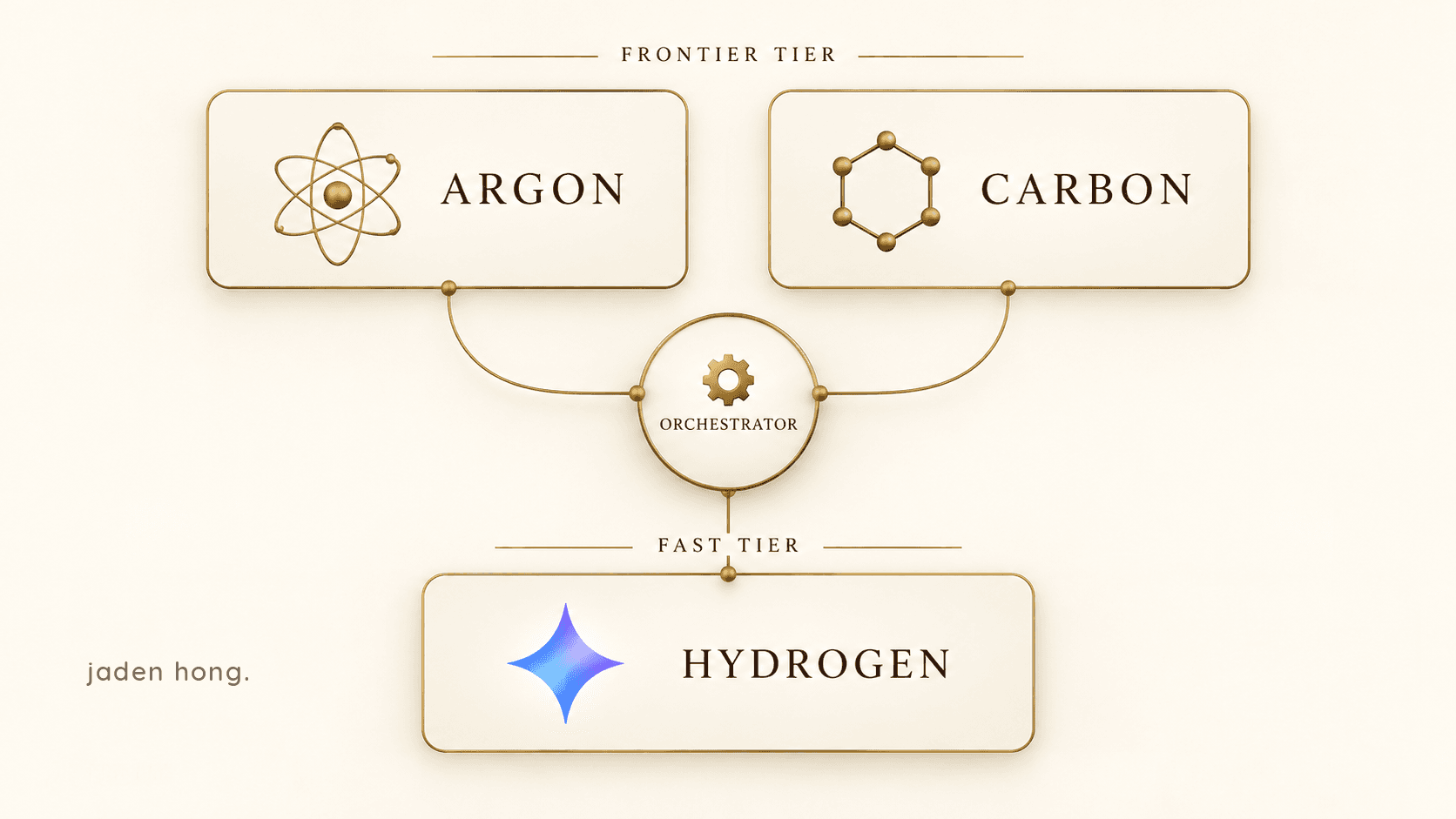
The Gemini 4 family now has a clean split. Argon and Carbon sit at the frontier, built for deep, long problems. Hydrogen is built for rapid execution: the everyday agent work where speed compounds, because every step waits on the one before it.
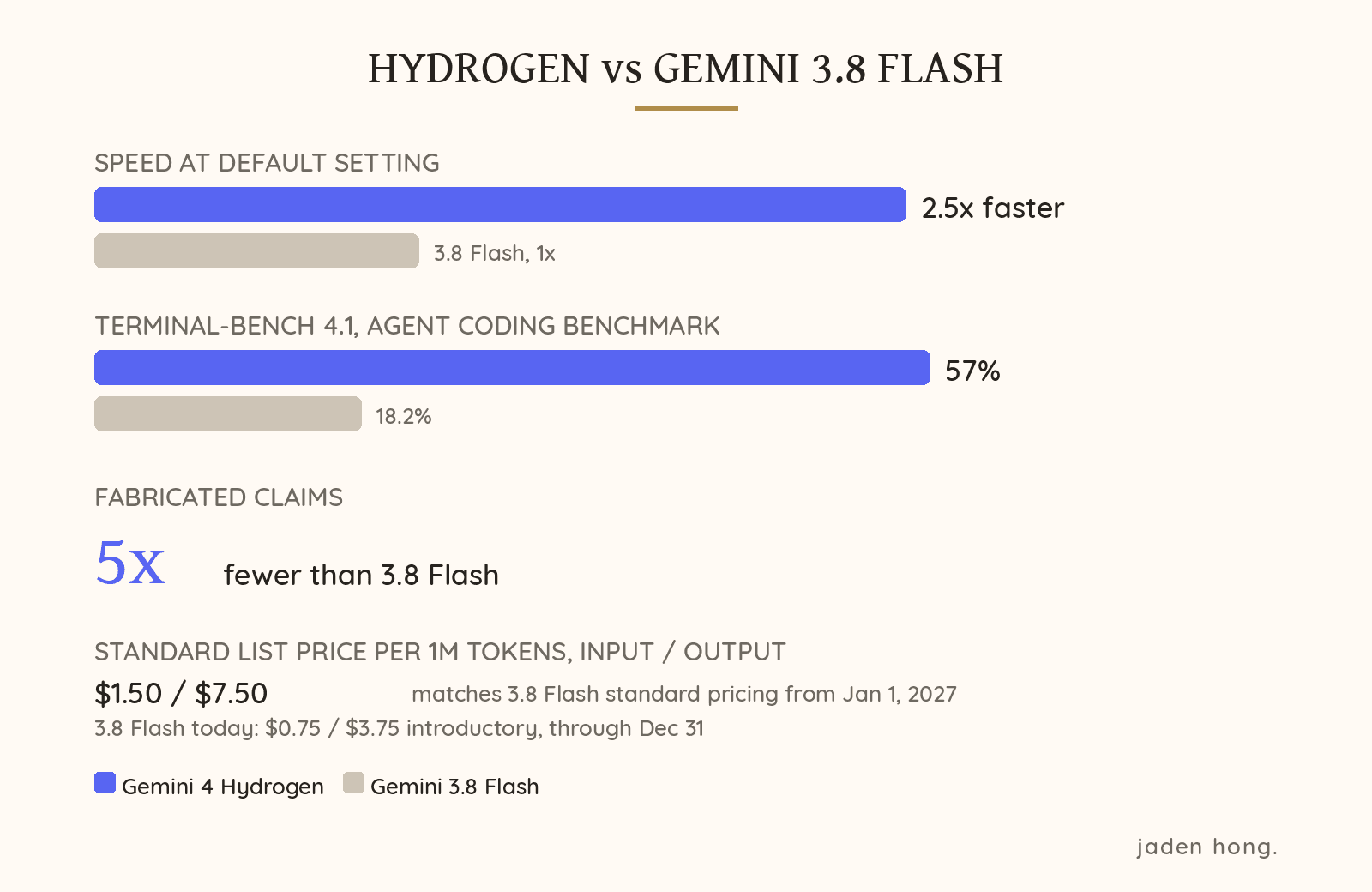
Against its predecessor the jump is not subtle. Google says Hydrogen finishes tasks 2.5 times faster than Gemini 3.8 Flash at the default setting, more than triples its score on the agent coding benchmark it cites, 57 percent against 18, and cuts fabricated claims by a factor of five. The standard list price matches what 3.8 Flash moves to on January 1: a dollar fifty per million input tokens, seven fifty per million output. Until then Flash still sells at half that under introductory pricing, so today Hydrogen costs twice the model it replaces. One early access customer, Box, reports its agent went from 74 to 79 percent accuracy, in less than half the time, on slightly fewer tokens.
Notice what Google did not do. It did not cut the price. At standard rates, the cheapest rival fast models list at about a fifteenth of that per token. Google is betting that for agent work, businesses pay for the model that finishes the job without breaking, not the one that is cheapest per call. Its new Orchestrator makes the same bet inside the product: it switches between Carbon and Hydrogen within a single session, and Google says that pairing reached near frontier success rates while using about a quarter less quota and finishing about a fifth faster.
What I am watching (Jaden's take)
For anyone actually running agents, the default tier matters more than the frontier. My agents do not need the smartest model on every step. They need a fast, honest one on most steps and a smart one on the few that count. In an agent loop, speed is not a luxury metric. Every step waits on the last, and faster steps do not lower the token bill by themselves. What a faster model changes is what a full run costs in time, which is the cost you actually feel.
My read: this is Google pricing reliability, not tokens. If agents really become how work gets done, the winner of the fast tier matters more than the winner of the benchmark charts. Watch whether the cheap rivals answer with reliability numbers of their own. That is the real fight now.
Generated cover and diagrams. Benchmark figures are from Google's own announcement.
Sources
Read next

Blog
Your Mac Just Hired an AI Employee
Gemini can now use apps, files and websites on your Mac, working in a background window while you keep your screen. What that changes for people who run businesses on AI.

Blog
The Biggest IPO Ever Is an AI Company
Anthropic raised $81.3 billion at $83 a share, the largest market debut on record. What it changes for people who build on Claude.

Blog
Did Your Agent Actually Finish?
OpenAI's new GPT-6.2 models score higher and cost less. The system card admits they sometimes stay silent about what blocked them.