Blog
QuickBooks Will Now Chase Your Invoices and Draft Your Books
At Intuit Connect, QuickBooks picked up AI agents that chase unpaid invoices, draft transactions for bulk posting, and prepare the monthly close. What is live, what is still pilot, and what to ask your accountant.

In late October in Las Vegas, Intuit used its Connect conference to rebuild its story around AI agents. Most of the keynote was aimed at accountants. The part that matters to you is simpler: the software that holds your books is starting to do the chasing.
Start with cash. A new needs attention module in QuickBooks watches for rising unpaid invoices, benchmarks your collections against anonymized similar businesses, and offers a one click weekly invoice chaser. If getting paid on time is your most boring weekly task, that is the feature to look at first.
Then the books themselves. QuickBooks now prefills transactions field by field so you can review and post them in bulk. Exceptions come back flagged with the policy and the reason, and you can set required fields and materiality thresholds per client or across the business. A separate cleanup agent proposes a plan to consolidate and deduplicate your chart of accounts. It inactivates accounts rather than deleting them, and it only touches transactions after the books closed date.
Two more announcements round it out. You will be able to create QuickBooks invoices from live customer data inside ChatGPT and Claude, though Intuit notes a third party account may be required. And the biggest piece, Agentic Books Close, is in pilot: you upload your own close procedures, the agent does the routine work your way, flags what needs attention, and logs every action. Intuit says nothing posts without explicit review. Pilot sign up runs through late November, it is free during the pilot, and it becomes a paid add on afterward.
Intuit's own figures say the platform draws on data from 10 million businesses and a network of 650,000 accountants, that more than 250,000 accounting firms use its Accountant Suite, and that those firms save more than nine hours per client per month. It also says AI already categorizes over 400 million transactions monthly and estimates a 30 percent reduction in manual work for accountants. Treat all of that as the company's own reporting, not independent measurement.
One honest caveat: most of the agentic features are tagged pilot or beta, and Intuit now labels every experience as pilot, beta, or generally available so you can tell finished from experimental. General availability dates for several headline features were not announced.
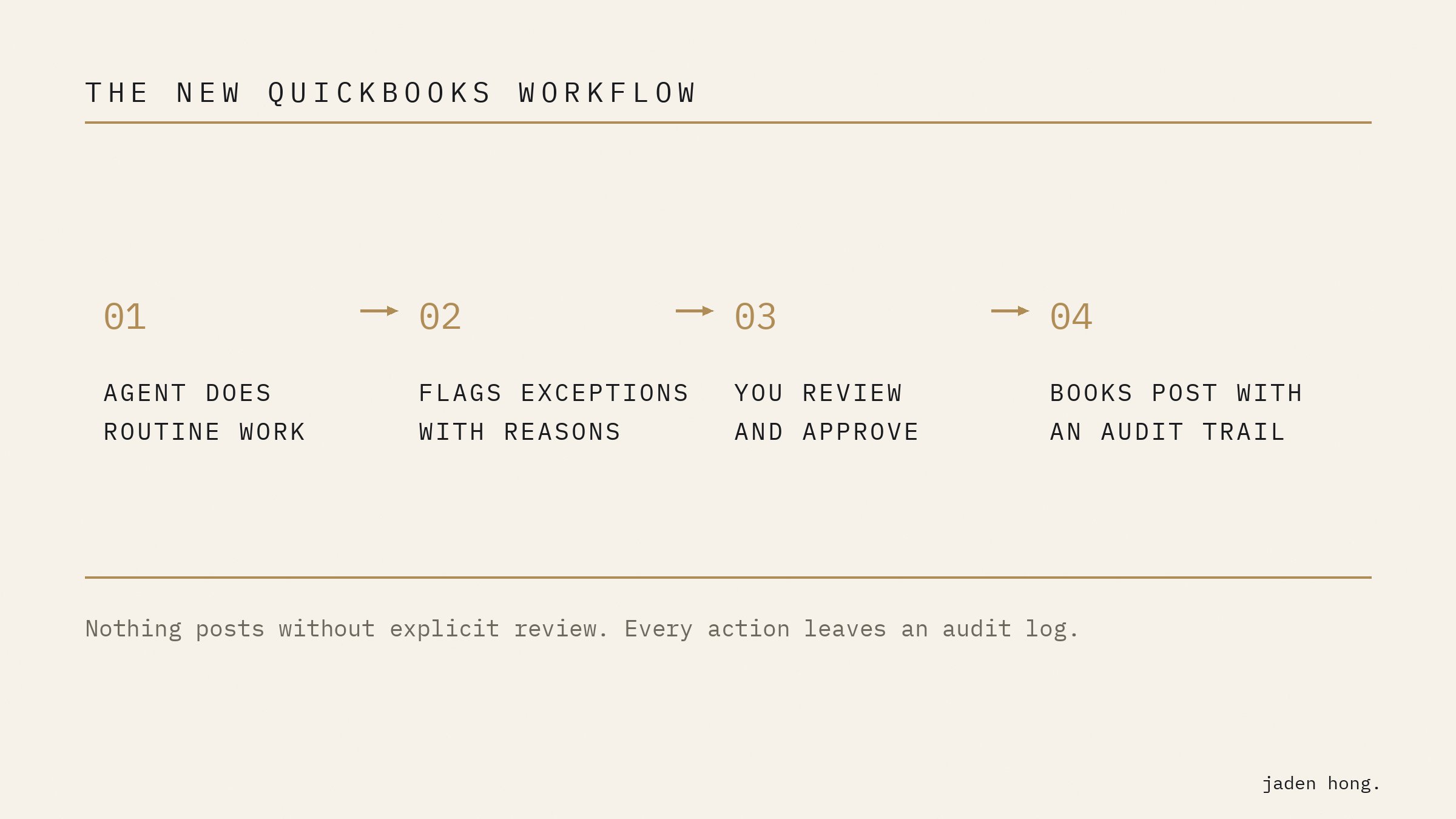
The control model Intuit is betting on: the agent handles routine work and flags exceptions with reasons, but posting waits for your review and every action lands in an audit log.
What it means for operators (Jaden's take)
My read: this is the second workflow in two days where the default flips from doing the work to reviewing it. Bookkeeping is followable rules plus judgment calls, which is exactly the shape agents take over first.
If you run on QuickBooks, act in order. Turn on the needs attention flags and the invoice chaser now, because those are the least risky features and the most directly tied to cash. Set your materiality thresholds before you let anything post in bulk. Treat the nine hours claim as a vendor promise until you have measured your own month. And ask your accountant which agents they plan to trust with your file, because nothing posts without review only protects you if someone actually reviews.
The businesses that win here will not be the ones that automate the most. They will be the ones that check the exceptions fastest.
Read next

Blog
ChatGPT Is Now a Fifth of Google Search, OpenAI Says
OpenAI says ChatGPT now runs one fifth as many searches as Google. What that number actually counts, why it still is not website traffic, and the three checks a small business should run this week.

Blog
Your AI Account Is Now Worth Stealing
Google's incident responders say criminals are hijacking cloud AI access and reselling it, leaving victims with bills above $100,000 in a single day. How the scheme works and how to lock your accounts down.

Blog
One Line in robots.txt Will Soon Tell Major AI Companies: Don't Train Here
Google, Microsoft, OpenAI and Anthropic have agreed to honor a single AI training opt-out in robots.txt. Here is what the shared signal does, what it does not do, and when it actually arrives.