Blog
When Does AI Move First?
The newest AI agents start work on their own and message you first. The real question is when they decide to move: on a schedule, on an event, or on their own timing.

For the last two years, using AI meant the same loop: you ask, it answers. The newest agents flip that. They start work on their own, message you first, and only speak up when something actually needs you.
So the question I ask about any agent now is not how smart the model is. It is when the agent decides to move.
On a schedule

The simplest trigger is time itself.
The agent runs at a set time, like a weekday brief at 8 AM. Predictable, easy to trust, easy to audit. This is how my morning brief works. It lands before I ask, and I read it with coffee.
On an event

The signal starts the work.
A new GitHub issue, a mention in Slack, a webhook from another app. The agent waits for the signal and starts the moment it arrives. You get an answer in minutes instead of the next morning.
On its own

Awake while the office sleeps.
The agent decides when to look again: it checks unfinished work, notices that something changed, and comes back only when there is something worth saying. The hard part is not moving first. It is staying quiet when nothing matters.
Six agents, three styles
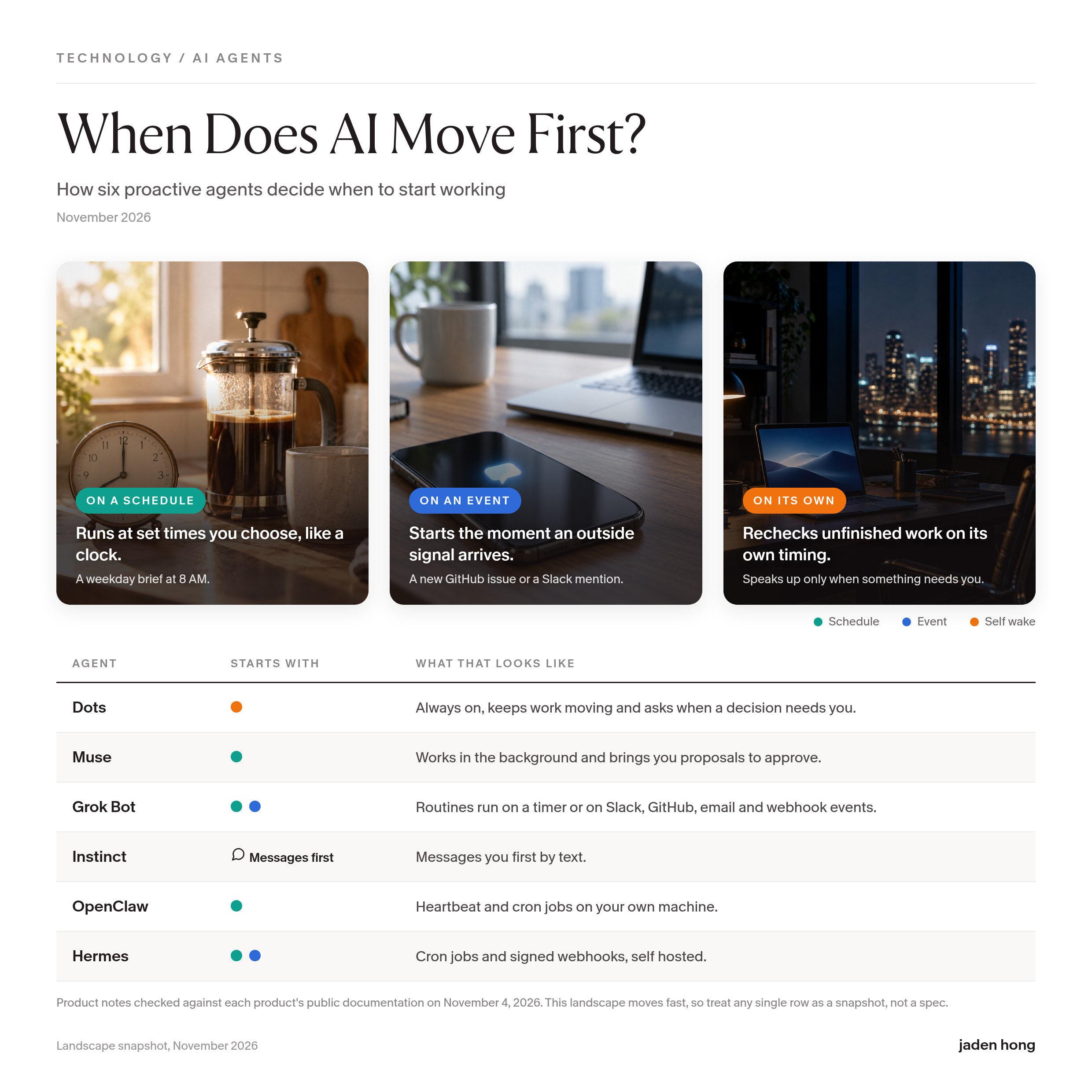
One image version: schedule, event, and self wake across six tools.
- Dots: self wake. Always on, keeps work moving and asks when a decision needs you.
- Muse: schedule. Works in the background and brings you proposals to approve.
- Grok Bot: schedule and event. Routines run on a timer or on Slack, GitHub, email and webhook events.
- Instinct: messages first. Reaches you by text before you ask.
- OpenClaw: schedule. Heartbeat and cron jobs on your own machine.
- Hermes: schedule and event. Cron jobs and signed webhooks, self hosted.
Product notes checked against each product's public documentation on November 4, 2026. This landscape moves fast, so treat any single row as a snapshot, not a spec.
The pattern: the good ones combine all three. A morning brief, instant replies to real events, and quiet rechecks in between.
My take
Most people shop for the smartest model. I care more about when it moves. A brief that arrives at 8 AM without asking saves the first hour of my day, and an agent that taps me only when a decision is needed beats a faster chatbot.
But the bar for moving first is high. An agent that starts on its own reads my email and my issues with my logins. Trust matters more than features. Pick the tool whose quiet you can live with, not the one that talks the most.
Read next

Blog
ChatGPT Is Now a Fifth of Google Search, OpenAI Says
OpenAI says ChatGPT now runs one fifth as many searches as Google. What that number actually counts, why it still is not website traffic, and the three checks a small business should run this week.

Blog
Your AI Account Is Now Worth Stealing
Google's incident responders say criminals are hijacking cloud AI access and reselling it, leaving victims with bills above $100,000 in a single day. How the scheme works and how to lock your accounts down.

Blog
One Line in robots.txt Will Soon Tell Major AI Companies: Don't Train Here
Google, Microsoft, OpenAI and Anthropic have agreed to honor a single AI training opt-out in robots.txt. Here is what the shared signal does, what it does not do, and when it actually arrives.