Blog
Claude Can Now Read Your Bank Account (and Only Read It)
Anthropic's new Personal Finance feature connects Claude to your bank through Plaid with read only access. What it can see, what it cannot do, and how a small operator should actually use it.

On November 5, Anthropic launched Personal Finance in Claude. You connect your bank and card accounts through Plaid, and from then on you can ask Claude questions about your real money: where it went, what is coming out before payday, which subscriptions you are still paying for. The access is strictly read only. Claude cannot move, manage, or invest a dollar.
It is rolling out in beta this week in the US, on the Pro, Max, and Ultra plans, across web, desktop, iOS, and Android. Free, Team, and Enterprise plans do not have it, and the rollout is gradual, so you might not see it yet.
What it actually does
Once your accounts are linked, a Personal Finance hub appears in Claude's sidebar. Widgets show your spending, cash flow, account balances, subscriptions, and upcoming bills on one page, and you can rearrange them. The chat sits on top of the same data.
The examples Anthropic gives are the questions everyone asks late in the month. "Where did my money go?" gets you a spending total broken down by category. "Is that more than usual?" makes it compare against previous months and point at the membership renewal you forgot. "Anything look off?" sends it scanning across every connected account for charges that hit twice, unexpected fees, or a bill that has crept up all year. You can also ask it to explain a term like APR, then add up what yours has cost you this year. Ask for a weekly spending chart or a dashboard of the numbers you choose and it builds one you can keep adjusting.
What Claude can see, and what it cannot do
You sign in to your bank through Plaid, the same network behind most finance apps, so Claude never asks for or sees your bank password. For each account you choose to share, Claude reads the bank's name, the account name, type, and last four digits, balances and credit limits, and up to 24 months of transactions with amount, date, merchant, and category. For investment and loan accounts it reads balances and credit limits only, not holdings, trades, rates, or terms. You can link up to 16 banks, unlink any of them whenever you want, and disconnect everything at my.plaid.com.
The limits matter as much as the access. Claude cannot move money, pay bills, or invest. Anthropic is explicit that it is not designed to give investment advice, that Claude can make mistakes, and that you should check important figures against your bank. Balances can lag a day or two, and an account linked through two different logins can get counted twice in your totals.
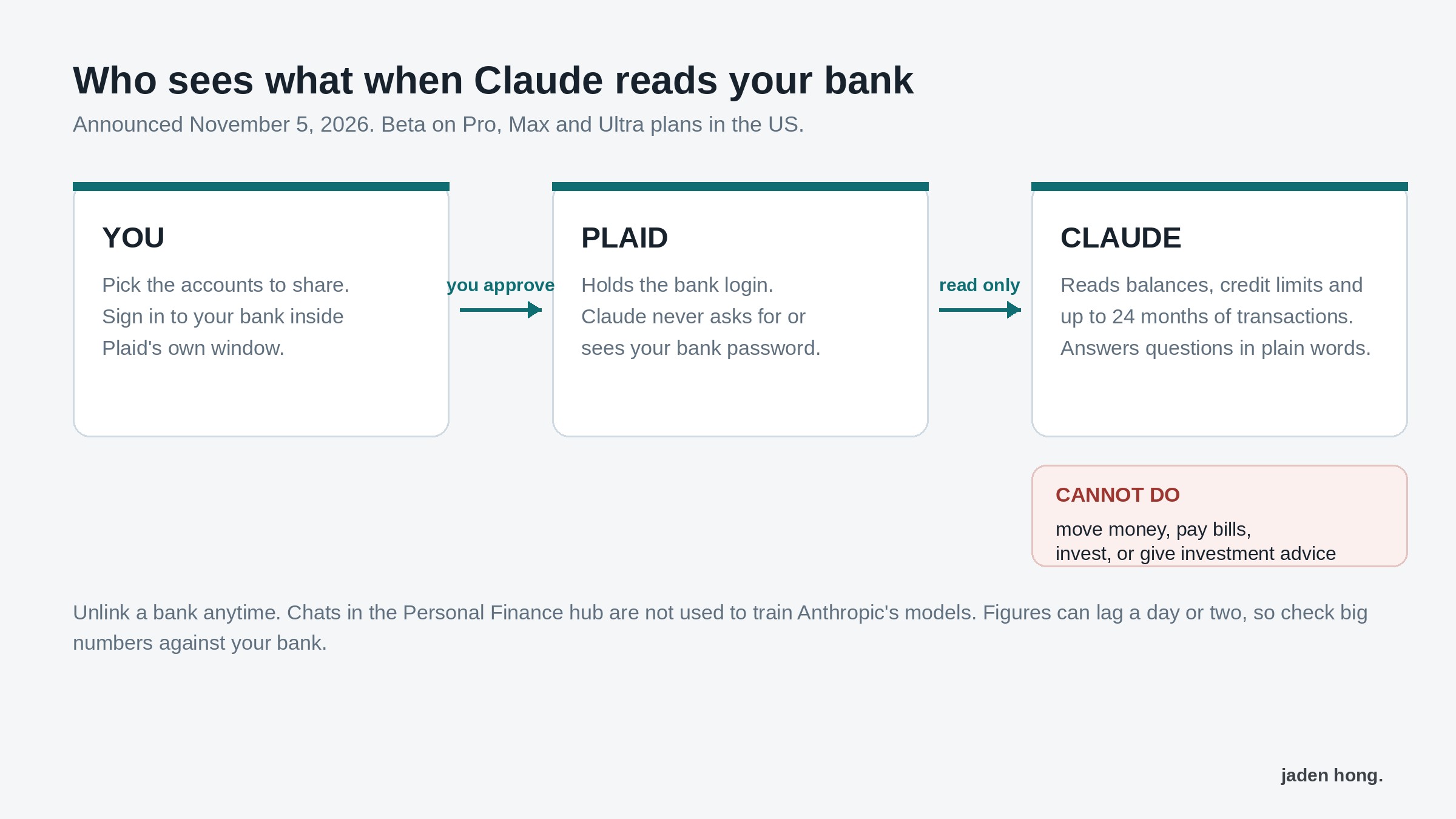
The privacy details are unusually specific for a consumer AI feature. Chats in the Personal Finance hub are not used to train Anthropic's models. Once Claude has used your accounts in a chat, that chat is kept out of memory, out of search, and out of your monthly recap. Two gotchas are worth knowing before you get comfortable: a shared chat link shows the figures from your accounts to whoever opens it, and a published artifact can show them too.
Why this is happening now
Plaid says more than 800 AI companies now build on its pipes, and that nearly two thirds of US users who connected a bank account to an AI assistant through Plaid had never used a Plaid powered finance app before. Plaid's own research says 69 percent of US consumers will share personal data with AI in financial services when they see a clear benefit, and half think managing money without AI will soon feel outdated. Those are Plaid's numbers, so read them as a company talking its market up, but the direction checks out: ChatGPT added a similar Plaid based bank connection back in May, and now Claude has one. Talking to an AI about your actual balance is becoming a default, not a novelty.
Anthropic is also unusually blunt about the endgame. Personal Finance is "a first step," and it says bigger money decisions belong with licensed professionals and regulated firms, which it is now inviting to build with it. Today it reads. The plan is clearly to advise.
What it means for operators (Jaden's take)
My read: this is a personal finance feature, but the useful move for an owner is to treat it as a second pair of eyes on the business accounts you already watch, not as a finance department.
Connect one business checking account first, not your whole financial life. The help docs explicitly support a second login at the same bank for a business account, so you can keep the scope tight. Then use it for the questions that normally wait for your bookkeeper: what changed this month, which recurring charges grew, what is scheduled to hit before the next deposit. It reads up to two years of transactions, which makes "is this normal?" a question you can finally ask your own data.
Keep the division of labor straight. Yesterday I wrote about QuickBooks agents that chase invoices and draft your books. Those do the work. Claude with a bank connection does none of that work; it just lets you interrogate the results. The pattern across both is the trust model: AI gets read access to your money first, and earns the right to act later. Read only is the right shape for this stage.
Two cautions before you connect anything. First, the numbers can be stale or wrong, and Anthropic says so itself, so any figure that would drive a decision gets checked against the bank's own app. Second, be careful with share links and published artifacts from money chats, because they carry your balances to whoever opens them. If you run a Team plan, you cannot use this yet anyway; this beta is a solo plan feature.
The floor for "AI that touches my money" just moved from typing numbers into a chat to the chat reading the ledger itself, with the password kept out of reach. That is a real shift, and for once it shipped with the guardrails on by default.
Read next

Blog
QuickBooks Will Now Chase Your Invoices and Draft Your Books
At Intuit Connect, QuickBooks picked up AI agents that chase unpaid invoices, draft transactions for bulk posting, and prepare the monthly close. What is live, what is still pilot, and what to ask your accountant.

Blog
ChatGPT Is Now a Fifth of Google Search, OpenAI Says
OpenAI says ChatGPT now runs one fifth as many searches as Google. What that number actually counts, why it still is not website traffic, and the three checks a small business should run this week.

Blog
Your AI Account Is Now Worth Stealing
Google's incident responders say criminals are hijacking cloud AI access and reselling it, leaving victims with bills above $100,000 in a single day. How the scheme works and how to lock your accounts down.